For many years, music education has followed a familiar pattern. Students are introduced to notation, scales, technical exercises and the interpretation of music written by others. These are undoubtedly valuable skills, but I have often wondered whether we sometimes place too much emphasis on learning the language of music before allowing students to express themselves through it.
After all, children learn to speak long before they learn to read and write. They experiment with sounds, imitate what they hear and gradually discover how to communicate their own thoughts. Why should music be so different?
The importance of musical imagination
Creativity is not something that should be reserved for advanced musicians. It is a natural part of learning, and one that can be encouraged from the very beginning.
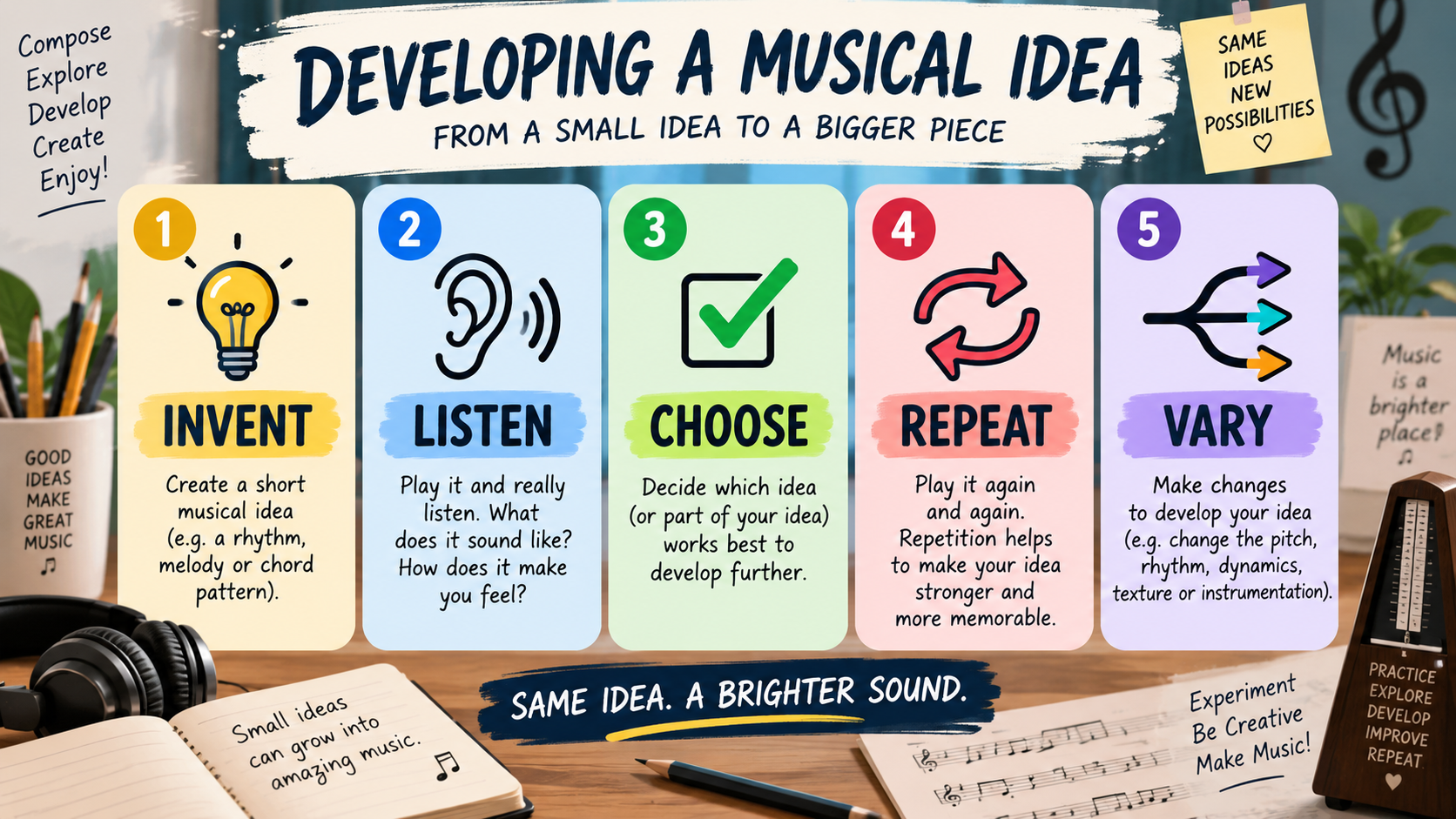
A student who has only recently discovered a handful of notes on the piano is already capable of making musical decisions. Those notes can be arranged into a melody, repeated to create a pattern, or altered to produce something entirely different.
The results may be simple, but the experience is significant. The student is no longer simply reproducing somebody else’s musical ideas. They are beginning to develop ideas of their own.
This sense of ownership can be enormously motivating.
Learning through discovery
One of the most rewarding aspects of teaching composition is watching students discover musical principles for themselves.
A change of rhythm can transform a melody. Repeating a phrase can create a sense of familiarity. Altering the final note can make a musical idea feel complete or leave it suspended in anticipation.
These discoveries become particularly meaningful when students experience them through their own creative work.
Rather than treating musical theory as a collection of rules to be memorised, we can introduce it as a way of understanding things that students have already begun to hear and explore.
The theory then has a purpose. It explains an experience rather than simply describing an abstract concept.
Confidence before complexity
Perhaps one of the greatest obstacles facing young musicians is the belief that composing music must be difficult.
Students often imagine that a composition needs to be long, complicated or technically impressive before it can be considered worthwhile.
Yet some of the most memorable musical ideas are remarkably simple.
A short phrase built from three or four notes can contain everything necessary to begin a composition. What matters is not the number of notes available, but the imagination brought to their use.
By giving students manageable creative challenges, we can help them experience the satisfaction of producing something musical without becoming overwhelmed by technical demands. Confidence grows through achievement, and each small success creates the possibility of another.
Creativity and musical understanding
Encouraging composition does not mean abandoning the traditional disciplines of music education.
Technique, notation, listening and theoretical understanding remain essential. But creative work can give these disciplines a more immediate relevance.
A student who has struggled to write down a melody of their own may suddenly appreciate the value of notation. Someone experimenting with harmonic accompaniment may become curious about chords and their relationships.
In this way, creativity becomes a powerful means of developing musical understanding rather than something separate from it.
The different elements of music education begin to reinforce one another.
Making music personal
Ultimately, music is a form of human expression.
While learning to perform the works of great composers is an immensely valuable experience, I believe students should also have opportunities to discover what they themselves might wish to express.
Their first compositions may be modest, imperfect and sometimes surprising. But they represent something important: the beginnings of an individual musical voice.
Not every student will become a composer, just as not every child who enjoys writing stories will become a novelist.
That is not the point.
The ability to imagine, experiment, make choices and communicate ideas has value far beyond any particular musical achievement.
If we introduce creativity at the beginning of musical education, rather than treating it as a reward for technical proficiency, we may help students develop not only a deeper understanding of music, but a more personal and lasting relationship with it.
And surely that is one of the most worthwhile ambitions of music education.