
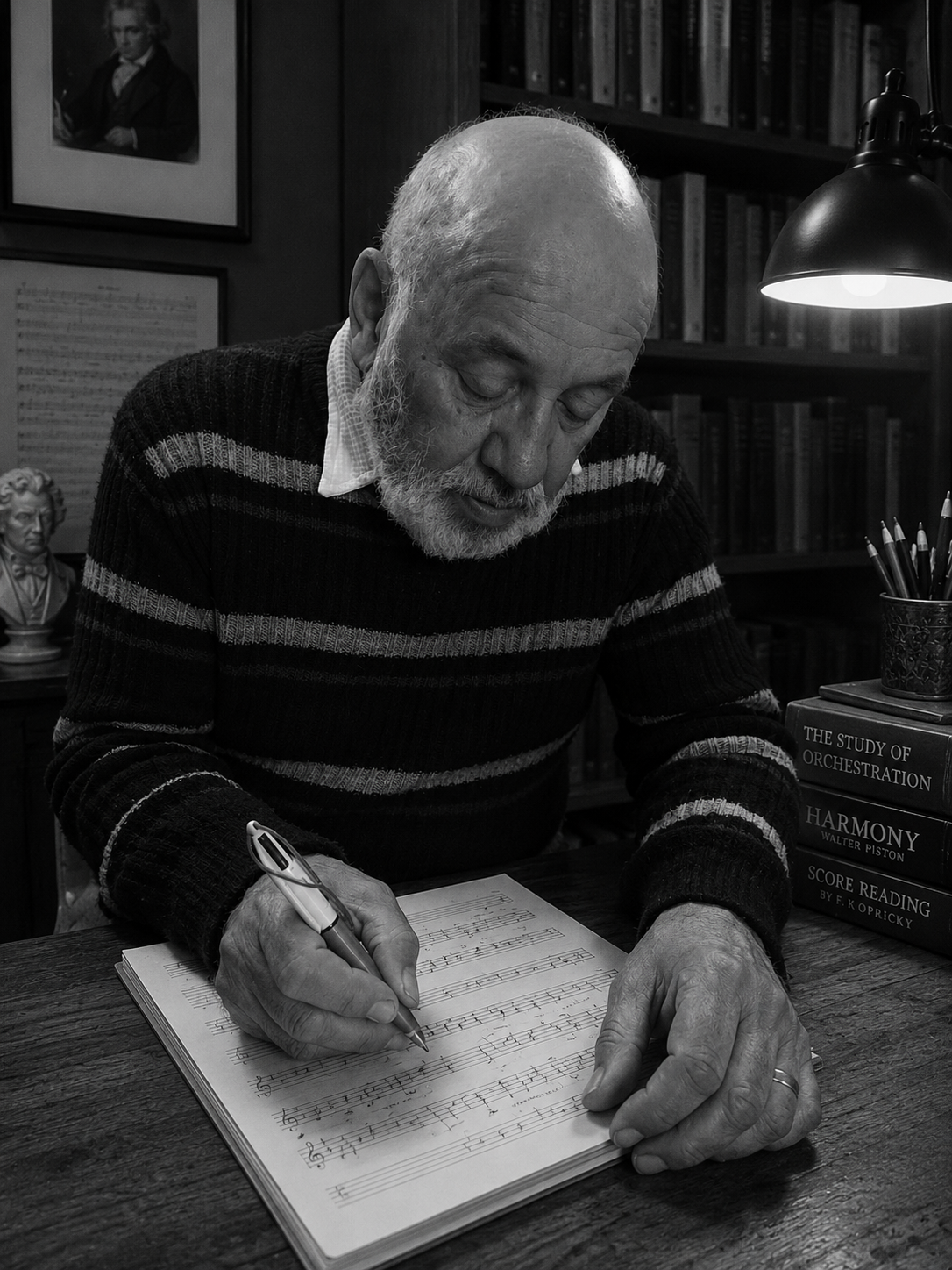
There’s a version of composing that looks suspiciously good in films.
The room is dark. The piano is waiting. The composer plays a chord, stops, stares into the middle distance, then suddenly finds the idea. Within minutes, music is pouring out. Theme, harmony, structure, emotion — all apparently arriving together, as though somebody upstairs has just opened the tap.
Real composition is usually less cinematic.
It involves coffee going cold beside a laptop. It involves listening to the same eight bars 27 times. It involves moving one note up a semitone, deciding you hate it, moving it back, then changing the entire section because the note was never the problem in the first place.
This is not evidence that inspiration has failed.
This is creativity.
The myth of the brilliant idea
Musicians love origin stories.
The melody came in a dream. The chorus appeared in ten minutes. The riff was discovered while messing around during soundcheck. The score practically wrote itself.
These stories are irresistible because they suggest that great music begins with a great idea.
Sometimes it does.
But even when a musical idea arrives suddenly, it rarely arrives from nowhere.
A composer has spent years filling the cupboard. They have absorbed chord progressions, grooves, voicing, orchestral colours, production tricks, rhythmic patterns and melodic shapes. They have heard hundreds of pieces and probably forgotten most of them consciously.
Then, one afternoon, two or three of those things collide.
The result feels new because the connection is new.
That matters, because the myth of the brilliant idea can be surprisingly destructive. Sit down to write with the expectation that your opening bars should immediately sound inspired, and you have created an excellent system for avoiding composition altogether.
The melody is too obvious.
The chords sound familiar.
The rhythm is boring.
Delete. Start again.
An hour later, you have a beautifully organised session file called New Idea 14 and no music.
Good composers are not necessarily people who begin with better ideas. Often, they are people who know what to do with average ones.
Creativity is a process
A useful musical idea does not need to arrive wearing a tuxedo.
It can be embarrassingly small.
Three notes. A rhythmic cell. A bass line. A strange chord voicing. A texture. A single interval.
The real question is not, “Is this idea brilliant?”
It is, “What can I do with it?”
This is where composition actually gets interesting.
Take a four-note motif and put it in the bass. Stretch it. Chop off the final note. Harmonise it differently. Put it against a rhythm it was never designed for. Move it into another register. Let another instrument interrupt it.
Now the idea has stopped being an object and become material.
That shift is crucial.
Composers often get stuck because they judge ideas too early. They audition them as if every sketch were applying for a permanent position in the piece.
But sketches are not finished music. Their purpose is to reveal possibilities.
The first version of a section might exist only to show you why the second version needs to be different.
That is not wasted work.
It is the work.
Composition is full of strange reversals like this. The melody you thought would carry the whole track ends up as a background figure. The throwaway chord change becomes the emotional centre. The “temporary” ending survives to the final mix.
You discover the piece by making it.
The discipline of showing up
This is the part nobody puts on the poster.
Creativity needs routine.
Not always the glamorous kind, either. Sometimes it is simply opening the project when you do not particularly feel like opening the project.
Musicians understand this instinctively in other areas.
You would not expect to become a better pianist by playing only when overcome by a powerful desire to practise C-sharp minor scales. You would not expect an orchestra to rehearse only when everybody felt spiritually aligned.
Yet composition is often treated differently, as though writing music requires a special internal weather condition.
It doesn’t.
A composing habit is useful precisely because it removes some of the pressure from each session.
You do not have to write the defining work of your career by 11am.
You might only need to fix the transition into the second section.
Or write eight bars.
Or find a better bass movement.
Or make the strings sound less like they are arriving at a royal wedding.
Small tasks are powerful because they keep the piece moving.
And movement matters. Once you are working, you begin to hear things. Problems become specific. Solutions suggest themselves.
The middle section is not “bad”; it is too static harmonically.
The melody is not “boring”; it repeats before enough tension has built.
The arrangement is not “wrong”; everything is occupying the same register.
These are problems you can solve.
“I am not inspired” is much harder.
Making space for ideas
There is, however, a danger in turning creativity into pure productivity.
Composers also need empty space.
Not every useful musical decision happens in front of the instrument.
Sometimes you need to leave the room.
Walk somewhere. Make food. Sit on a train. Listen to something completely unrelated to what you are writing. Let your attention loosen its grip.
It is remarkable how often a solution appears once you stop demanding one.
You suddenly hear that the chorus should start two bars earlier.
You realise the melody does not need another phrase.
You understand that the problem with the orchestration is not the number of instruments, but the number of ideas happening at once.
This kind of distance is not laziness. It is part of the process.
So is listening.
Not passive background listening, but curious listening. Follow the inner parts. Notice when the bass disappears. Listen to how long the composer delays the obvious resolution. Ask why a groove feels heavy when very little is actually playing.
Those observations build your vocabulary.
And eventually, some tiny detail will reappear in a piece of your own, transformed by everything else you know.
That is how creativity usually works.
Not as a bolt from the blue, but as an accumulation of attention.
Yes, inspiration exists.
There will be days when the melody lands immediately, the harmony behaves itself and the entire piece seems to know where it wants to go.
Treasure those days.
But do not build your creative life around them.
Because most music is written somewhere between inspiration and stubbornness: in the drafts, the revisions, the experiments, the deleted sections, the wrong turns and the small discoveries that happen only because you stayed with the piece.
Creativity is not the moment the idea arrives.
It is what you do next.
Leave a Reply